This Africa month, JUMO’s Chief: Payments Partnerships, Brad Roper, reflects on how JUMO’s work to make finance more accessible contributes to economic growth in Africa by supporting small businesses focusing on sustainability.
Africa’s economy is on a promising trajectory. According to the African Economic Outlook, real GDP growth is expected to reach 4.3% in 2025, up from 3.7% the previous year. But even with that growth, more than half the continent’s adult population remains unbanked. Micro, Small & Medium Enterprises (MSMEs) generate as much as 80% of employment, but face an estimated $330 billion credit gap according to the World Bank. The challenge isn’t growth itself. It’s making growth possible.
This is where financial inclusion comes in. When millions of entrepreneurs can access capital, savings, and basic financial tools, they are open to greater opportunity to innovate, employ others and build for future generations.
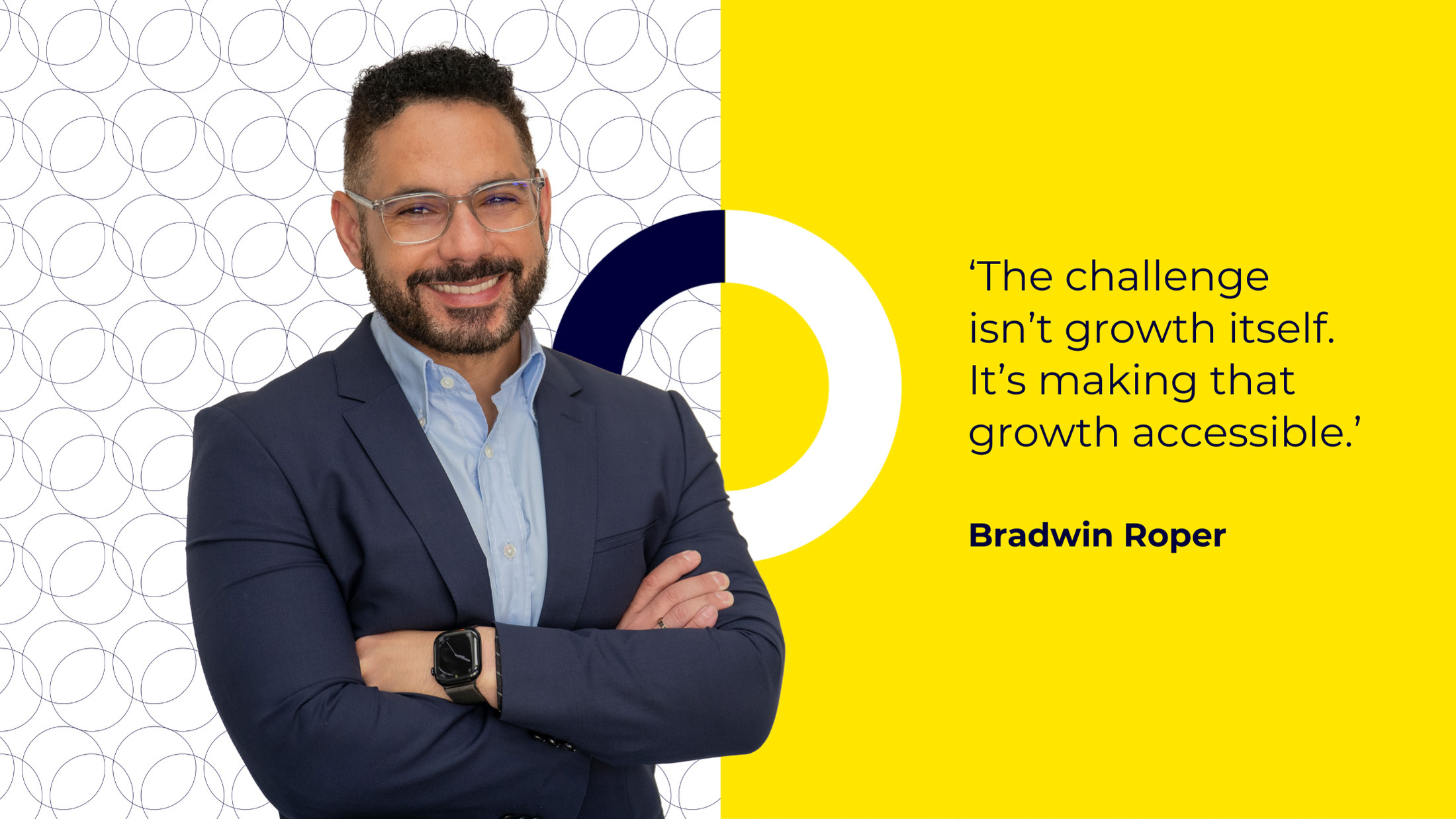
The challenge isn’t growth itself. It’s making sure that growth is accessible.
At JUMO, we provide the infrastructure that enables banks and mobile network operators to build fit-for-purpose financial products. Our AI-driven platform creates new ways to deliver inclusive, data-informed credit and savings tools.
JUMO’s reach, region by region – one customer at a time
- In Ghana, MSMEs comprise over 90% of all businesses, yet many lack access to formal financial services. JUMO’s partnerships with various partners, including MTN, Letshego, Absa and Ecobank, are working to narrow this gap by offering digital credit products that support everyday business needs.
Take Eugenia, a teacher and mother of two in Accra, as an example. To supplement her income, she runs a small beading business. When expenses exceed her savings, she turns to QWIKLOAN, powered by JUMO, to buy supplies or manage family emergencies.
- In Zambia, MSMEs make up 97% of all businesses. Their ability to access flexible finance improves their success outcomes. Through the Kasaka loan, built in partnership with MTN and Absa Bank, JUMO is helping entrepreneurs build sustainability.
For example, Steria Mwansa Kunda, a poultry farmer in Chingola, used her first Kasaka loan to buy 20 chickens. Today, she runs a thriving business with over 100 livestock without relying on loan sharks.
More than anything, JUMO’s financial access directly facilitated Steria’s entrepreneurial journey and improved her livelihood.
- While the use of mobile money continues to grow in East Africa, many in rural parts remain outside of economic ecosystems. JUMO’s collaboration with partners like Airtel in Tanzania, Kenya and Uganda is helping reach them by bringing credit services to areas where traditional banking doesn’t reach.
In Kenya, KopaCash, built by JUMO, has helped over 639,000 people (58% in rural areas) manage urgent needs, from school fees to business capital. Available via USSD, it removes digital barriers and shows how inclusive design can drive economic resilience across communities. - In Benin, JUMO’s Float Loan is helping mobile money agents overcome cashflow constraints and grow their operations. Since its launch in 2024, the product has enabled agents to access up to XOF 3.2 million (USD 5,500) in working capital, with a 99% monthly repeat rate.
By removing the barriers to access to traditional supply chains or costly informal loans, agents can increase their daily wallet inflows up to fivefold. The product’s strong performance has also attracted interest from distributors looking to reduce risk and improve efficiency, marking a significant step forward for financial inclusion and economic empowerment in the country.
- Even in countries like South Africa, where banking systems are widely accessible, there are still pockets of financial exclusion, particularly among informal workers and low-income earners. JUMO’s work with MTN on products like QwikloanZA with MTN Momo helps bridge that divide.
At JUMO, we see financial inclusion as a growth driver, and AI is one of the most powerful tools we use to support this.
Our systems enable responsible lending in real time, even for people without formal credit histories. This means more small businesses are supported, more jobs are created, and more communities are strengthened.
Read more of our customer stories.